
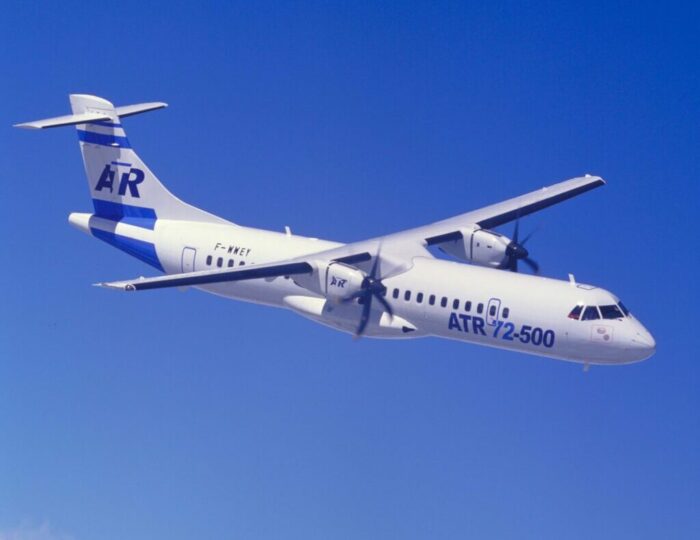
ATR Celebrates 45 Years as the Leading Benchmark in Regional Turboprop Aviation. European aerospace joint venture ATR marked its 45th anniversary following its inception on November 4, 1981, when Aérospatiale (now Airbus) and Aeritalia (now Leonardo) merged their regional aircraft engineering expertise. Originally established to meet an estimated global forecast of approximately 400 aircraft by the turn of the century, ATR has far exceeded those initial projections, logging more than 1,950 total orders and completing over 1,750 aircraft deliveries worldwide. Today, supported by an international team of 1,400 employees, ATR manages the largest flying regional turboprop fleet across the commercial sector.
Join us on Telegram, Twitter, LinkedIn, Facebook, Instagram, YouTube, WhatsApp, TikTok, and subscribe to our Weekly Digest with just one click.
The platform’s operational flexibility spans diverse regional airline environments across Asia-Pacific, Europe, Africa, and Latin America. In India, the aircraft anchor regional development by linking secondary population centers with metropolitan economic hubs, while in remote areas such as Canada’s Nunavut territory, ATRs provide essential transport for passengers, food, and cargo across gravel and ice runways. Looking ahead, ATR sees a potential 300-aircraft opportunity in the United States to restore point-to-point regional routes, helping replace over 800 direct city-pair connections that were discontinued over the past two decades. Route networks vary from 15-minute island-hops flown by Air Tahiti between Papeete and Moorea to open-ocean segments taking nearly four hours.
Follow us on Google News and receive notifications on your mobile device by clicking the button below.

ATR’s engineering lineage started with the maiden flight of the ATR 42 in August 1984, entering commercial service with Air Littoral in 1985, followed by the stretched ATR 72 introduced with Karair in 1989. Evolutionary steps followed with the -500 series in 1995 and the -600 series cockpit upgrade in 2011. Assembly lines in Toulouse currently deliver ATR 72-600 airframes powered by Pratt & Whitney PW127XT engines, burning 45% less fuel than comparably sized regional jets on short-haul routes. Looking to the next operational phase, the planemaker is channeling investments into the EVO concept and European Clean Aviation research initiatives to drive fleet decarbonization without sacrificing community access.
| Milestone / Metric | Operational Detail |
|---|---|
| Foundation Date | November 4, 1981 (Airbus and Leonardo) |
| Aircraft Sold | Over 1,950 aircraft |
| Aircraft Delivered | Over 1,750 aircraft |
| Global Workforce | Approximately 1,400 employees |
| Flagship Variants | ATR 42, ATR 72 (-500 and -600 series) |
| Current Engine Option | Pratt & Whitney PW127XT (-45% fuel burn vs. regional jets) |
| Future Programs | ATR EVO concept and Clean Aviation research |
Must-Watch Video:
You might also be interested in:
- ✈ Avianca makes rapid progress in software updates and passenger service.
- ✈ Air Canada launches direct flights from Toronto and Montreal.
- ✈ Airbus warns of potential solar radiation issues in aircraft.
- ✈ Viva resumes operations in Guadalajara and Puerto Vallarta.
You must be logged in to post a comment.